
How to Choose the Best Roll Thermal Paper
Choosing Roll Thermal Paper is not just a matter of finding the right width. A roll that looks correct can still jam, fade, or leave uneven print. The details matter. Core diameter, paper thickness, coating quality, and printer compatibility all shape daily performance. A few careful checks can prevent wasted rolls and interrupted service.
For a transparent expert perspective, consider this original illustrative quote from a fictional sourcing specialist, Mira Chen: “Choose the roll for the printer, the conditions, and the print job—not price alone.” This is an editorial line, not a verified quotation from a real industry expert. The principle is practical: match the roll to the equipment first, then compare material quality and cost. A café may prioritize fast, legible receipts, while a warehouse may need labels that remain readable during handling. Different jobs. Different demands.
This guide explains how to compare Roll Thermal Paper by size, grade, and intended use. It also covers storage, print clarity, and common buying mistakes. Look closely at the roll’s core. Check the printer specifications. Test a sample when possible. Even so, no checklist replaces real-world testing. Paper can behave differently across devices and environments. A small trial may reveal issues that a product description misses.
Understanding Roll Thermal Paper and Its Printing Uses
Roll thermal paper has a heat-sensitive coating that darkens when it passes over a heated printhead. The printer creates text and images directly on the paper, so no ink cartridge is needed. No ink is needed. This makes direct thermal printing useful for quick, frequent jobs. However, the printed image can fade with heat, sunlight, or prolonged friction.
At a checkout counter, a narrow roll can produce receipts within seconds. In kitchens, order printers use thermal rolls to print clear tickets that staff can read beside a busy grill. Wider rolls may suit transaction records or point-of-sale systems. Small direct thermal label rolls are used for shipping labels, shelf tags, and queue tickets. The paper type and printer must match; a roll that is too wide or has the wrong core may not fit.
Choosing a roll starts with checking the printer’s supported width, core size, and maximum roll diameter. Then consider the print job. A receipt used briefly may need different durability from a label handled during packing. Paper coating affects contrast and print clarity, too. Store rolls in a cool, dry place, away from direct sunlight. It sounds simple, but the right choice is not always obvious: printer specifications can be confusing, and paper descriptions vary. A small test roll can reveal whether text stays sharp at the printer’s usual speed.
Checking Printer Compatibility and Roll Dimensions
Printer compatibility starts with the specifications, not the price. Check the printer manual for supported paper width, maximum roll diameter, and core size. A roll may fit the holder but still be too wide for the print path. Small mismatch, big headache. Also confirm that the printer uses direct thermal paper; thermal rolls are not interchangeable with ordinary paper.
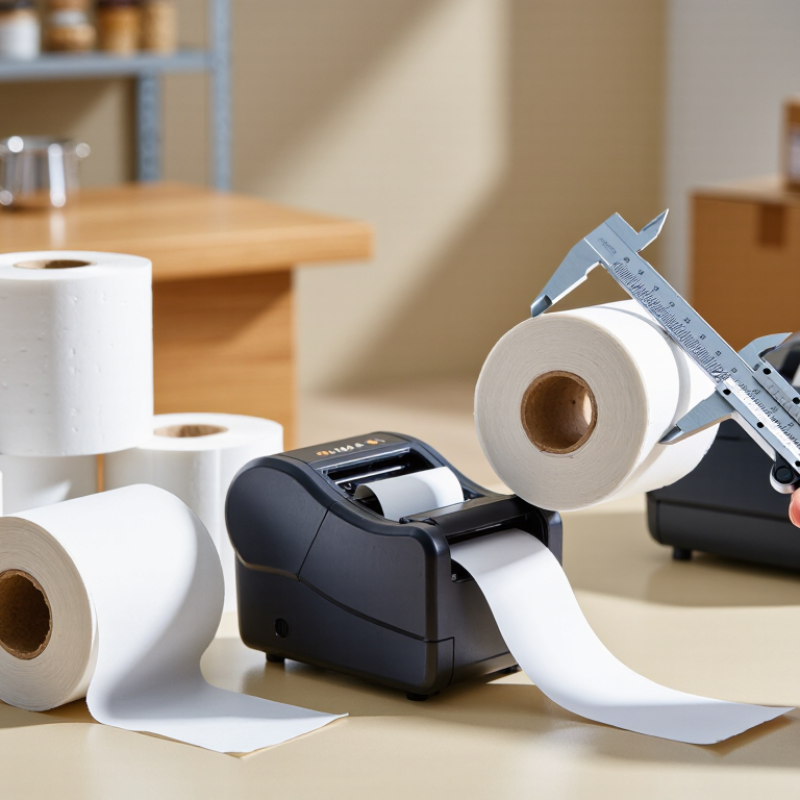
Measure an existing roll if you have one, including its width and outside diameter. Check the cardboard core too, since some holders need a particular inner diameter. Confirm which side is heat-sensitive by following the printer’s loading diagram or testing a short feed. The coating can be hard to identify by sight alone. I would recheck the measurements before ordering; it is easy to rely on a rough estimate and regret it later.
Tips: Keep the old roll’s label or write down its dimensions. Compare every measurement with the printer guide, and leave room for the roll to turn freely. Avoid forcing a tight fit. If the printer feeds unevenly, check the roll’s direction and seating before assuming the device is faulty. A quick test print can reveal smudging, faint text, or feed problems.
Comparing Paper Grades, Coatings, and Print Durability
How to Choose the Best Roll Thermal Paper
Paper grade affects thickness, opacity, and how smoothly a roll feeds through a printer. Standard-grade paper suits short-lived receipts. Top-coated grades add a protective layer that can better resist oils, moisture, and handling. But coatings vary; a glossy surface alone does not prove longer print life. Ask for the supplier’s image-retention data and the storage conditions used in testing.
Print durability depends on more than the paper. Heat, sunlight, friction, and cleaning chemicals can fade or darken thermal images. ASTM D4332 gives a useful conditioning benchmark for materials: 23°C and 50% relative humidity, each with a small permitted tolerance. It is not a thermal-paper lifetime guarantee. Test sample rolls in your actual printer, then check legibility after storage and routine handling. Small differences matter.
Tips: Match the grade to the receipt’s expected life. For a ticket kept in a warm car, choose a tested protective coating and store it away from windows. Check the core size, roll width, and printer compatibility, too. A durable coating cannot fix a poor fit. I would also keep a sample from each delivery; paper can behave differently across batches.
How to Choose the Best Roll Thermal Paper
Comparing common paper grades, coatings, and print durability
The chart compares common nominal basis weights, not a durability ranking. Heavier paper can feel sturdier, but print resistance to fading, heat, moisture, and handling depends mainly on the thermal coating and any protective topcoat. Check the paper supplier’s specifications and your printer’s requirements before choosing a roll.
Assessing Core Size, Roll Length, and Storage Needs
How to Choose the Best Roll Thermal Paper
Assessing Core Size, Roll Length, and Storage Needs
Core size is easy to overlook until a roll refuses to fit the printer spindle. Measure the core’s inner diameter, then check the printer’s maximum roll diameter and width. These three measurements matter more than a roll’s advertised length alone. Roll length depends on paper thickness as well as the roll’s outer and core diameters. For example, a roll with an 80 mm outer diameter, a 12 mm core, and 0.07 mm-thick paper holds roughly 70 metres. Treat that as an estimate; winding tightness and actual paper thickness can change the usable length. A common mistake is comparing rolls by diameter without checking the core.
Storage affects whether receipts remain legible. Keep unopened rolls in their original packaging, away from heat, direct sunlight, moisture, oils, and cleaning chemicals. ISO 18935:2014 evaluates thermal-paper image stability under dark-storage, light-exposure, and water-contact conditions. That testing framework is a useful reminder: a roll’s performance depends on its environment, not just its specifications. Check the supplier’s stated storage limits, and rotate stock so older rolls are used first. Even a sensible storage setup is not a guarantee of permanent records. For long-term retention, test a sample under your actual storage conditions before ordering in bulk.
Choosing a Supplier Based on Quality, Cost, and Standards
A reliable roll thermal paper supplier should prove performance, not just quote a low price. Grand View Research’s 2023 Thermal Paper Market report valued the global market at USD 4.1 billion, reflecting broad demand across retail, transport, and healthcare. For buyers, growth makes consistent supply important, but it does not guarantee consistent rolls. Request samples and check roll width, core size, winding, and print density on your actual printers. A faint receipt or dusty printhead can cost more than a small price difference.
Ask for technical data on image stability and storage conditions. ISO 18936:2012 provides methods for assessing the stability of thermal images under heat and humidity. Confirm that the supplier can share relevant test results, batch traceability, and clear specifications for coating and paper weight. Compare delivered cost per usable roll, including freight, rejects, and storage—not just the unit price. I have found that sample rolls can look fine at first, then fade sooner than expected. That deserves a second check.
Tips: Test samples on your busiest printer. Keep receipts for several weeks in a warm, bright area, then compare legibility. Ask suppliers how they control batch variation and handle failed lots. A polished specification sheet helps, but it is not a substitute for repeatable results.
