
2026 Best Thermal Print Paper Types for Global Buyers
Choosing the right Thermal Print Paper is more complicated than comparing roll prices. Global buyers must consider printers, storage conditions, application risks, and regional requirements. A receipt roll used in a dry retail counter may fail in a humid warehouse. The same paper may also perform differently on another printer.
This guide examines the main thermal paper types available in 2026. It covers standard receipt paper, long-life paper, direct thermal label stock, color-changing paper, and phenol-free alternatives. Each type has a practical purpose. Each also has limitations. That matters.
Paper thickness, coating sensitivity, core size, and roll diameter can affect feeding performance. Image durability matters when receipts support returns, accounting, or product traceability. For labels, adhesive strength and surface compatibility deserve equal attention. A low-cost roll may create faded text, paper dust, or frequent cutter problems. Those small failures can become expensive across thousands of transactions.
Reliable sourcing requires more than a supplier’s product description. Buyers should request technical data, sample rolls, coating information, and test results when available. They should also confirm compliance with applicable chemical, packaging, recycling, and workplace rules in each target market. Requirements can change. Verify them.
Real-world testing remains essential. Store samples near heat, light, and moisture before approval. Check readability after transport and handling. No single Thermal Print Paper type suits every country, printer, or business model. Even experienced buyers can overlook storage conditions. This overview offers a practical starting point, while encouraging careful testing before large-scale purchasing.
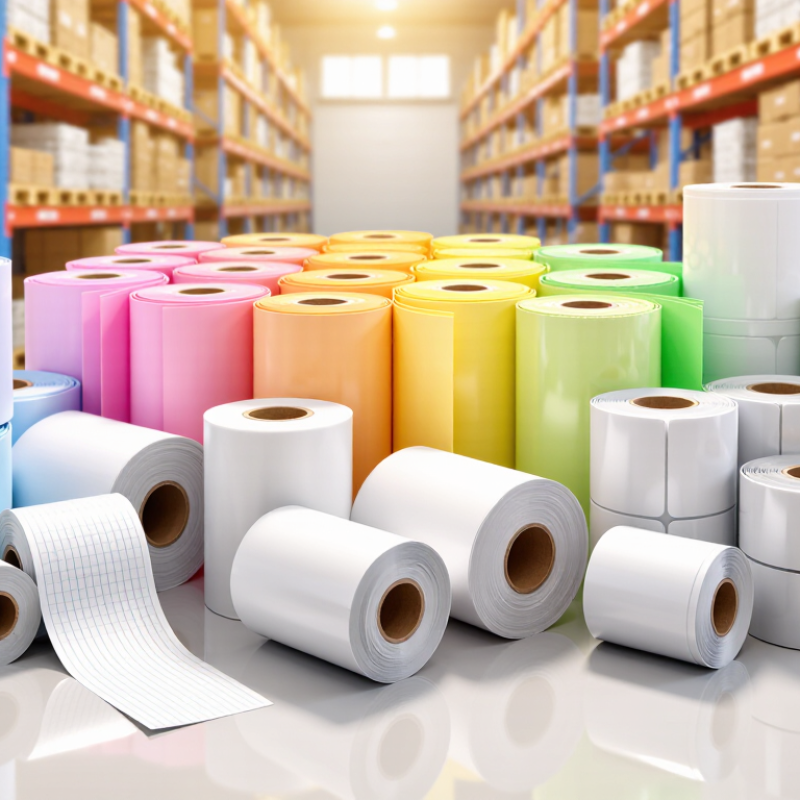
Thermal Print Paper: Definition, Structure, and Printing Principles
Thermal print paper is a paper-based substrate designed to create images through controlled heat. It usually contains a base paper, a coating layer, and a protective top layer. The coating includes color-forming chemicals and a developer. When heated, these materials react and produce dark marks. Unlike ordinary paper, it does not require liquid ink for direct thermal printing. Its surface feels smoother than standard office paper.
Direct thermal paper reacts inside the printer’s heated printhead. Dark areas appear where the head applies precise heat. This method suits receipts, queue tickets, and short-term labels. Thermal transfer paper works differently. A heated ribbon transfers ink onto the paper surface. The printed image usually resists light, moisture, and handling better. However, the process needs both ribbon and compatible equipment. Small settings matter. Excessive heat can darken the background or damage the coating.
Global buyers should match paper type with storage conditions and product life. Direct thermal paper may fade under sunlight, high temperature, or prolonged friction. For shipping labels, a stronger topcoat can improve readability during transport. Buyers should check roll width, core size, coating uniformity, and printer compatibility. They should also request chemical compliance documents for the target market. A practical trial remains necessary. Paper specifications can look perfect, yet feed unevenly in real machines. Humidity is often overlooked. It should not be.
2026 Best Thermal Print Paper Types for Global Buyers
Thermal Print Paper: Definition, Structure, and Printing Principles
This chart compares representative basis-weight midpoints for common direct thermal paper types. Basis weight is shown in grams per square meter (g/m²); actual specifications vary by application, coating design, caliper, and converting requirements.
Direct thermal paper normally consists of a paper or synthetic substrate, a thermal imaging layer, and optional topcoat or backcoat layers. A thermal printhead applies controlled heat to activate a leuco dye and developer, creating an image without ink or toner. Standard grades suit receipts, while top-coated, synthetic, and linerless grades are selected when improved protection, durability, or label flexibility is required.
Main Thermal Paper Types and Their Key Material Differences
Direct thermal, thermal transfer, and specialty thermal papers differ mainly in their coating chemistry. Direct thermal paper contains heat-sensitive leuco dyes and developers. A printer activates the image through a heated printhead. It needs no ribbon. Thermal transfer paper uses a wax, resin, or blended ribbon instead. Heat transfers ink onto the paper surface, creating stronger resistance to moisture, abrasion, and sunlight.
According to Smithers’ 2024 thermal printing market analysis, thermal printing remains important across retail, logistics, healthcare, and manufacturing. The report highlights rising demand for durable identification and tracking labels. Grand View Research also reports continued growth in the global thermal paper market, supported by point-of-sale receipts and shipping labels. However, market growth does not make every grade suitable. Standard direct thermal stock may darken inside a delivery van. A top-coated grade usually performs better. It also costs more.
Tips: Ask for the base weight, coating structure, image density, and storage test results. For short-life receipts, standard direct thermal paper may be sufficient. For outdoor labels, consider thermal transfer with resin ribbon. Phenol-free options can reduce chemical concerns, but “eco-friendly” claims require evidence. This area is still imperfect. Suppliers may describe coatings differently, so buyers should request test samples under real humidity, heat, and friction conditions. A simple 30-day field test can reveal failures that laboratory data misses.
2026 Best Thermal Print Paper Types for Global Buyers - Main Thermal Paper Types and Their Key Material Differences
| Paper type | Typical applications | Main material structure | Key coating or chemistry | Typical basis weight | Image and durability characteristics | Best buying considerations |
|---|---|---|---|---|---|---|
| Standard direct thermal paper | Receipts, queue tickets, payment records, weighing labels and short-term documents | Cellulose paper base with a heat-sensitive imaging layer and optional protective topcoat | Leuco dye, developer and sensitizer activated by a thermal printhead; formulations may be phenol-based or phenol-free | Approximately 48–80 g/m² | Sharp, fast black imaging; generally intended for temporary or moderate-term use and sensitive to heat, light, plasticizers and chemicals | Confirm printer compatibility, roll dimensions, image density, curl performance and chemical-compliance requirements |
| Phenol-free direct thermal paper | Retail receipts, transport tickets, healthcare records and applications requiring restricted-chemical control | Cellulose base, thermal imaging layer and protective coating using a non-phenolic developer system | Does not intentionally use BPA or BPS as the thermal developer; alternative developer chemistry is used | Approximately 48–80 g/m² | Similar print performance to conventional direct thermal grades, but final durability depends on the specific formulation and topcoat | Request a current chemical declaration and verify compliance with the destination market’s restricted-substance rules |
| BPA-free direct thermal paper | General receipts, tickets and labels where bisphenol A is restricted or not preferred | Thermal paper base with a developer system that excludes bisphenol A | May use BPS or another alternative developer; “BPA-free” does not automatically mean phenol-free | Approximately 48–80 g/m² | Good immediate readability; resistance to heat, light and chemicals varies by topcoat and developer formulation | Do not treat BPA-free as equivalent to BPS-free or phenol-free; obtain a complete composition statement |
| BPS-free direct thermal paper | Receipts and labels for buyers seeking to avoid both BPA and BPS in the thermal developer system | Cellulose base with a non-BPS thermal imaging layer and optional barrier or topcoat | Excludes bisphenol S; the exact alternative developer should be identified in technical documentation | Approximately 48–80 g/m² | Print quality can be high, while archival behavior and chemical resistance depend on the complete coating system | Ask for third-party testing or a supplier declaration covering BPA, BPS and other intentionally added developers |
| Top-coated direct thermal paper | Outdoor labels, logistics labels, freezer labels, retail labels and documents exposed to handling | Cellulose base, thermal layer and an additional protective topcoat above the image-forming layer | Topcoat improves resistance to abrasion, moisture, oils, plasticizers and selected chemicals | Approximately 60–100 g/m², depending on coating thickness and end use | More durable than uncoated or lightly coated grades; still not automatically permanent or weatherproof | Match the topcoat to the actual exposure, including humidity, condensation, solvents, sunlight and abrasion |
| Synthetic direct thermal media | Industrial labels, cold-chain identification, laboratory labels and applications requiring tear resistance | Polyolefin or polyester film substrate with a thermal imaging layer and protective topcoat | Film substrate provides improved dimensional stability, tear resistance and moisture resistance compared with cellulose paper | Commonly approximately 60–120 g/m² equivalent, varying by film thickness and construction | Strong and moisture-resistant; image longevity varies and requires application-specific validation | Check printhead settings, static behavior, adhesive compatibility, recycling route and minimum application temperature |
| Two-sided thermal paper | Specialized tickets, tags, forms and applications requiring information on both sides | Paper base coated with heat-sensitive imaging layers on both the front and reverse sides | Two independent thermal coatings; some grades include back-side protection or anti-setoff treatment | Typically approximately 70–110 g/m² | Enables double-sided thermal printing but may require precise printer calibration and controlled heat settings | Confirm whether the printer supports duplex thermal media and test curl, feed reliability and image transfer |
| Thermal label stock | Shipping labels, product labels, barcode labels, shelf labels and inventory identification | Facestock, pressure-sensitive adhesive and release liner; facestock may be paper or synthetic thermal material | Adhesive may be permanent, removable, freezer-grade or hot-melt; silicone release liner supports label dispensing | Facestock commonly approximately 60–100 g/m², excluding adhesive and liner | Print quality depends on facestock smoothness; label performance also depends on adhesion, liner release and application surface | Specify label size, core and roll direction, adhesive type, surface energy, temperature range and barcode requirements |
| Linerless thermal paper | Weighed-goods labels, food-service labels, logistics labels and variable-length dispensing systems | Thermal facestock with a release coating and adhesive, supplied without a separate disposable liner | Silicone or other release technology prevents the adhesive from permanently bonding to the printed surface during winding | Typically approximately 55–90 g/m², excluding adhesive and depending on the construction | Reduces liner waste and permits variable label lengths; exposed adhesive edges may require careful handling and equipment design | Verify printer compatibility, die-cut or perforation pattern, adhesive transfer resistance and storage conditions |
Note: Basis-weight ranges are typical industry ranges rather than universal specifications. Actual performance depends on the thermal formulation, coating weight, topcoat, substrate, printer settings, storage conditions and intended service life.
How to Match Thermal Paper Types with Global Applications
2026 Best Thermal Print Paper Types for Global Buyers
How to Match Thermal Paper Types with Global Applications
Thermal paper selection should follow the application, not the lowest purchase price. Grand View Research estimated the global thermal paper market at about USD 4.4 billion in 2023, with continued growth through 2030. That expansion reflects demand from retail, transport, healthcare, and manufacturing.
For checkout receipts, standard direct thermal paper suits short-term records and moderate indoor handling. Choose top-coated grades for exposure to moisture, oils, or frequent contact. Logistics labels need stronger surface protection, especially when cartons face sunlight, friction, and temperature changes. Smithers’ The Future of Thermal Printing to 2028 highlights logistics and industrial identification as important growth areas. Test label readability after transport, not only after printing.
Healthcare and laboratory applications require stable imaging and controlled chemical performance. Use grades supported by technical documentation, migration testing, and batch traceability. For long-term archives, thermal transfer media may be safer than direct thermal paper because the printed image usually has better durability. It is not always the simplest option.
Regional conditions also matter. Humidity can weaken adhesive performance, while cold storage can reduce contrast. Run samples through the actual printer, applicator, packaging surface, and storage cycle. A perfect specification can still fail in a busy warehouse. I would also question vague claims such as “eco-friendly” without test methods, coating details, or disposal guidance. Reports from Smithers and Grand View Research provide market direction, but buyers still need application-level verification.
International Quality Standards, Sizes, and Compatibility Factors
2026 Best Thermal Print Paper Types for Global Buyers
International buyers should evaluate thermal paper by verified performance, not appearance alone. Direct thermal paper suits receipts, labels, and short-term records. Thermal transfer paper usually offers stronger image durability, but it requires ribbon equipment. Quality documents should identify coating uniformity, image density, storage conditions, and batch traceability. ISO 9001 certification supports production control, but it does not guarantee every roll’s printing quality. Buyers should also request testing for restricted substances under applicable regional regulations. Requirements can change.
Sizes must match the printer exactly. Check paper width, roll diameter, core diameter, and winding direction. Common widths may look interchangeable, yet a small difference can cause feeding errors. Length also matters because thick rolls may overload compact printers. Compatibility depends on more than dimensions. Confirm the printer’s thermal method, operating temperature, sensor position, and recommended paper sensitivity. Test samples under heat, humidity, friction, and sunlight. A clean first print is not enough.
Tips: Request a technical data sheet and recent inspection report. Test at the lowest practical print darkness. Store rolls sealed, dry, and away from direct light. Do not assume one specification works globally. I have seen purchasing teams overlook core size, then discover costly installation delays. That mistake deserves reflection. Supplier claims should be checked against independent or in-house testing.
Storage, Sustainability, and Purchasing Considerations for 2026
In 2026, thermal paper selection starts with the working environment, not the lowest quoted price. Direct thermal rolls suit receipts, labels, and short-term records. Top-coated grades handle moisture, oils, and frequent handling better. For shipping labels, adhesive performance deserves equal attention. A clean peel matters. Store rolls in cool, dry rooms, away from sunlight, heaters, plasticizers, and cleaning chemicals. A practical target is 18–25°C and 40–60% relative humidity, unless the supplier specifies differently. Keep cartons closed until use. Exposure changes print contrast over time.
Sustainability decisions need evidence. Ask for fiber origin, recycled content, coating chemistry, and disposal guidance. Phenol-free options can reduce concern around certain developer chemicals, but “eco” wording alone proves little. Request current safety data and test reports. Also check whether the paper works with existing printers; failed rolls create waste. Smaller cores, lighter packaging, and accurate roll lengths may reduce transport impacts. Yet a thinner grade is not automatically better. It may tear, jam, or require replacement. Some buyers focus on recycled content while overlooking rejected labels. That is an expensive blind spot.
Before a contract, test samples under local conditions. Print at low and high temperatures, rub labels, and inspect stored receipts after several weeks. Confirm core size, roll diameter, winding direction, image durability, and carton moisture protection. For global purchasing, request consistent specifications across factories and define acceptable variation. Include batch traceability and a process for handling defects. Forecast demand carefully; overstocked thermal paper can age before use. No single paper type wins every market. The best choice depends on device settings, record-retention needs, climate, and disposal systems.
